
Recodi and the challenge of sustainability
Reduce the environmental impact of industrial concrete floors, improving performance and durability.
The environmental impact of the concrete industry
Sustainability is no longer a "niche" topic but a contingent necessity on both the political and economic fronts.
With good reason, the World Economic Forum, in its 2020 report, highlights that << the first risk for the world economy is the failure of all the actions put in place to mitigate climate change >> and the related losses associated with natural disasters and extreme weather events.
In addition, today's world demographic context and increasingly in the coming years is experiencing a period of strong urbanization, concentrating most of the population in large metropolises to the detriment of the countryside.
In an increasingly crowded and ever-growing planet, the construction sector plays a fundamental role, especially with regard to the cement and concrete industry, which is faced with two apparently antithetical needs: to support the ever-increasing demand for buildings and infrastructures and to increase the protection of natural resources.
The data on the environmental impact of the construction sector, in particular for the production volumes of concrete, the material most used by man with the exception of water, are particularly alarming:
- 9% of global CO₂ emissions are produced by the concrete industry; value almost entirely absorbed by cement production (7-8%).
- The annual energy consumption of Portland cement clinker cement plants (variable depending on the technology deployed), equal to 1.4-1.6 ∙ 1010 GJ, is comparable to the energy consumption of the entire US residential sector in 2020.
- From 16 to 23 billion tons per year of consumption of natural aggregates, in particular sand and gravel.
- 65.7 km³ per year of water consumed, both from batching and for the production of binders, aggregates and additives. This massive use leads to very high "water stress", especially in developing countries that already suffer geographically from drought and desertification.
Proposals to improve the sustainability of the concrete industry
In this context, the primary objective is to reduce the environmental impact, as well as to improve the performance of concrete that increases its durability and consequently decreases maintenance and extends the useful life of the structures.
There are numerous alternatives, already available and used in the sector, which require the application or use of:
- New technologies for cement production, in particular Carbon Capture Utilisation and Storage (CCUS) techniques, which allow the capture and reuse of CO₂
- Low clinker cements, cements consisting of a high proportion of additional cementitious materials instead of Portland cement clinker that requires firing at high temperatures. CEM III is the cement with the lowest clinker content.
- Recycled or artificial aggregates, in accordance with the legislation that to date does not allow a 100% use of recycled aggregate (composed, for example, of demolition aggregates, milled asphalt, residues from the extraction of marble, tires and plastics, by-products of iron and steel origin and demolition waste).
There are also alternatives that are still being tested or that are less studied, such as the use of:
- Alternative binders to Portland cement, characterized by a low environmental impact.
- Additives and techniques that allow you to obtain durable and high-performance concretes.
- Non-potable water.
"Green" concrete floors, the role of design
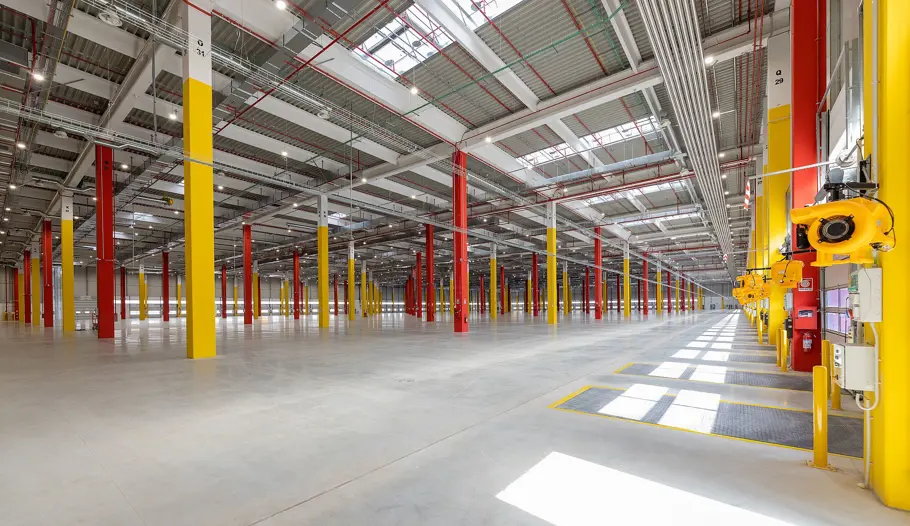
"Green" flooring of the logistics hub in Orbassano
Credits: SPIN MOVIE
In the application of the numerous alternatives on the market, which can reduce the environmental impact, design represents a crucial phase in the implementation of an intervention and especially in the creation of a "green" flooring.
An accurate formulation of the mix design and sizing contribute to achieving the sustainability of the flooring, as it allows the creation of a work capable of maintaining the performance levels for which it was designed over its nominal life and reducing maintenance to a minimum. A correct mix design also makes it possible to solve the technical limitations that may arise, such as: the high shrinkage of some systems, the greater demand for water or the low workability, the elastic modulus that can be slightly lower and the low resistance.
A thoughtful choice of materials with a view to reducing the use of natural raw materials and reducing energy and water consumption, as well as the use of aggregates derived from "waste" from other activities, contribute to the formulation of a sustainable mix design.
A careful choice of suppliers who adopt the most innovative technologies for cement production and are located at a distance of 10 – 15 km from the construction site in order to have less impact on pollution and maintain the quality of the product supplied.
Case history: logistics hub with "green" concrete floor
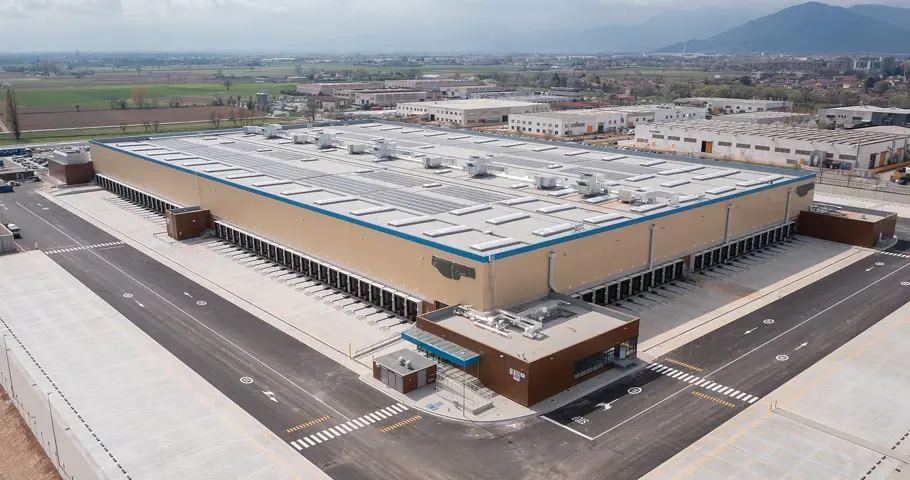
Logistics hub in Orbassano
Credits: SPIN MOVIE
During 2022 and the first part of 2023, we paved about 54,370 square meters of a logistics hub in Orbassano, in the province of Turin, commissioned by GSE Italia Srl on behalf of Vailog Srl.
The project pursues the Breeam International New Construction by Bre Excellent level certification and, in particular, it is the first logistics building in Italy – and among the first in Europe – to compete for the Zero Carbon certification by International Living Future Institute.
For the implementation of the intervention, 4 "green" concrete mixtures were designed by the Recodi Design Office with the use of CEM III composed of blast furnace slag (GGBFS), in order to reduce CO₂ emissions, and a percentage of recycled aggregate in accordance with current legislation. A resistance of 30 MPa was required for the internal area, while 37 MPa was required for the external area.
Both for the mix design formulated for the interior and exterior, as well as for that of the loading bays and for the office area, an ad hoc study was carried out in collaboration with the concrete batching plant and 7 pre-qualifications, in order to obtain an optimal result both in the processing phase and in the heating elements.
The parameters obtained with the "green" concrete mixture were compared with a traditional mixture, revealing significant savings in natural resources and energy consumption, as well as lower CO₂ emissions. The object of study was the warehouse of about 30,000 square meters and 22 cm thick.
| Parameters | Mix green vs traditional design |
|---|---|
| NRMC – consumption of natural resources | Save 2,650 tons of natural resources |
| GWP – calculation of CO₂ emissions for the production of a product | Save 1,100 tons of CO₂ emissions |
| GER – method of quantifying energy consumption for the production of a product | Save 1,320 GJ of energy |
In addition, we analyzed the strengths on the twenty-eighth day, with the breakage of the concrete specimens, finding that the "green" floor reported higher performance than that required in the design phase.
| Areas | Required resistances * | Resistances obtained |
|---|---|---|
| Indoor Area | Rck 30 MPa | Rck 32 MPa |
| Internal Area - Offices | Rck 30 MPa | Rck 34.74 MPa |
| Outdoor Area | Rck 37 MPa | Rck 39.68 MPa |
*Assuming a standard deviation of 4.5 MPa
Having also ascertained the final data, Recodi confirms its commitment to the research and implementation of procedures aimed at minimizing the environmental impact and contributing to the more conscious and sustainable building development.
The topic was exposed and discussed during the "Smart Floors" webinar on April 18.
it is possible to review the appointment entitled "Industrial concrete floors, MIN environmental impact vs MAX performance" at the link below or on the Recodi Youtube channel.
To make sure you don't miss the next dates: subscribe to the newsletter at the top of the site.
To receive the slides of the meeting,
Fill out the form, we will contact you as soon as possible.