
130,000 square meters of LEED certified flooring
The floors designed and built by Recodi for Figure 11 contribute to obtaining LEED certification in the "Material and Resources" and "Indoor Environmental Quality" categories.
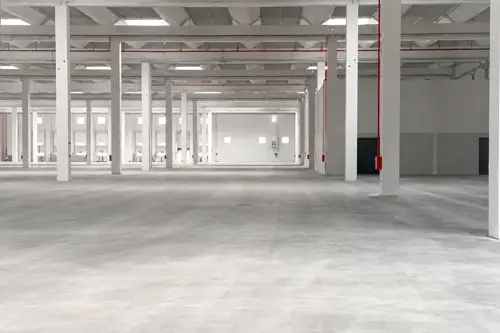
Sustainability is now an essential criterion in the design and construction of industrial environments, as it directly affects the overall environmental performance of the building, energy efficiency and the environmental responsibility of the intervention. The choice of materials, technologies and construction processes aimed at reducing environmental impact makes it possible to optimize the use of resources, limit emissions and ensure safety and durability over time.
In this context, LEED (Leadership in Energy and Environmental Design) certification is configured as an international reference standard for the assessment of the environmental performance of buildings. Through a structured system of measurable requirements and criteria, LEED provides an objective framework for verifying the level of sustainability of a project, enhancing solutions capable of combining construction quality, energy efficiency and reduction of impacts throughout the entire life cycle of the work.
LEED certification is a voluntary system for assessing the sustainability of buildings, applicable both to new constructions and to redevelopment interventions throughout the entire life cycle of the project. Developed by the U.S. Green Building Council and managed by the GBCI, it is based on objective and measurable criteria organized in a scoring system that analyzes the main areas of building sustainability. The score obtained determines the level of certification — Certified, Silver, Gold or Platinum — providing an internationally recognized reference for the environmental performance of the building.
In line with these principles, Recodi adopts an integrated and concrete approach to sustainability, which translates into design and operational choices aimed at reducing the environmental impact and durability of the industrial floors made. The attention to materials, production processes and the performance of flooring over time allows us to actively contribute to the requirements of LEED certification.
The "sustainability challenge", to reduce the environmental impact of industrial concrete flooring, is a contingent theme for Recodi. Already in 2022, the company distinguished itself for the design and construction of the first "green" concrete industrial floor in Italy.
DISCOVER THE FIRST GREEN FLOOR
In 2025, Recodi has carried out three important industrial flooring orders for Figura 11, an entrepreneurial reality active for over 40 years, which operates internationally in the real estate, industrial and alternative energy sectors, complying with the requirements of LEED Certification, v4 BD+C protocol: Warehouse.
The orders are developed in Northern Italy, from Verona to Novara passing through the province of Varese, for a total of about 130,000 square meters.
65,000 square meters of floors were created in San Pietro in Cariano, 25,000 square meters in Cameri and 40,000 square meters in Olgiate Olona, between inside and outside, using the latest generation S-28EZ Laser Screed vibratory spreader. Thanks to the 7.62-meter-long telescopic boom, the machine allows you to reduce the number of passes required and further increase efficiency in the field, improving overall productivity and pavement flatness.
Recodi's support stands out for the attention paid to the design of the concrete flooring, which will be used by the end customer for logistics activities.
The mix design, designed specifically to meet the criteria dictated by LEED certification, without neglecting high performance, has been conceived to achieve a recycled content of 5% by weight.
In addition, for the cement and aggregates, 100% recycled, present in the mixture developed by Recodi's design office, the relevant EPDs (Environmental Product Declaration) were presented, - a standardized and verified document that describes in an objective, transparent and comparable way the environmental performance of a product throughout its entire life cycle. -

The EPD represents a fundamental tool to support sustainable design choices and to contribute to the requirements of environmental certification systems, such as LEED, by providing traceable and comparable environmental information on the materials used.
Also, with regard to the polyethylene separation sheet, 100% post-consumer recycled, the pylons and construction joints, the related EPDs were presented.
For the electro-welded mesh, a "High Sustainability Steel" was chosen, characterized by a post-consumer recycled content of 98.6%, with the presence of EPDs.
The recycled content of the mixtures, steel and separation foil earned the MR Building Product Disclosure and Optimization Sourcing of Raw Materials credit.
The choice of silicates and resins, characterized by low content and low emission of Volatile Organic Compounds, GEV EMICODE EC1 certified and in possession of EPDs, has made it possible to obtain the EQ Low Emitting materials credit for the Paint and Coatings and Adhesives and Sealants categories.
In addition, the total number of EPDs submitted for the materials, used in the construction of the concrete floor, contributed to obtaining the MR Building product Disclosure and Optimization – Environmental Product Declarations credit.
The careful design combined with the choice of the most performing and sustainable materials has allowed the flooring created by Recodi to compete for LEED PLATINUM certification for the building in Cameri, in the province of Novara, and for the Olgiate Olona building in Varese; while the property in San Pietro in Cariano, in the province of Verona, competes for LEED GOLD certification.
"Recodi strongly believes in sustainable development and is committed every day to the search for innovative alternatives"
The company's development vision, called Recogreen, takes the form of projects, such as those commissioned by Figure 11, where the search for quality and sustainability play a central role.
Through constant analysis, optimization and technical updating, Recodi stands as a qualified interlocutor in projects in which sustainability is not an accessory element, but a measurable parameter that affects the overall value of the intervention and the quality of industrial spaces.
We would like to thank QSC Srl – Quality Survey Controls, an independent company that supports builders, developers, designers and investors in the construction market with experience and responsibility for the data collected, operating as an impartial and effective Control Body of the resources used in projects, with constant attention to environmental sustainability issues and human factors in operational contexts.