
Industrial flooring in summer
High temperatures determine the quality of concrete
High temperatures can change the behavior of concrete from the early stages of installation. The effects are particularly significant in castings carried out outdoors, which are more exposed to climatic conditions. For this reason, proper tillage planning and proper ripening management are essential to ensure the expected performance of the flooring.
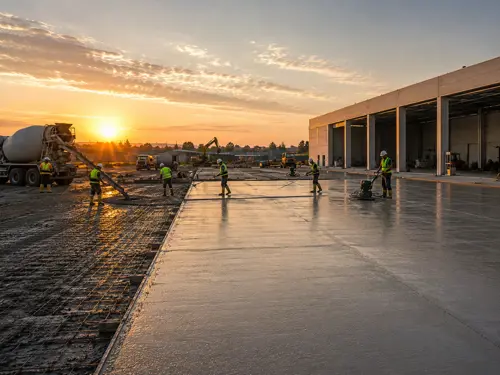
When do we talk about jet in hot climate?
The Technical Standards for Construction (Ministerial Decree 17/01/2018) and the related Application Circular no. 7 of 21/01/2019, together with the Guidelines for the installation of structural concrete of the Superior Council of Public Works draw attention to the importance of environmental conditions during laying operations.
According to the Guidelines of the Superior Council of Public Works, we speak of casting in a hot climate when the air temperature reaches or exceeds 32 °C during installation operations or in the hours immediately following.
However, temperature is only one element to be evaluated. Direct sunlight , wind and low relative humidity also help to accelerate the evaporation of the mixing water and the hydration process of the cement. It is therefore the set of environmental conditions that determines the behavior of concrete.
What are the main critical issues?
The increase in temperature accelerates the processes of water evaporation and hydration of the cement, modifying the behavior of the material from the early stages of processing.
Among the most common consequences are the rapid reduction of the workability of the concrete, a greater complexity in the laying, compaction and finishing operations and an increase in the risk of discontinuity between successive castings. In these conditions, early cracks due to plastic shrinkage can also occur.
The effects are not limited to the executive phase. Inadequate management can also affect the behavior of the pavement over time, leading to greater shrinkage deformations, cracking phenomena related to thermal tensions and a shorter durability of the work.
For an industrial flooring, called upon to withstand high loads, continuous traffic and constant stresses, preventing these critical issues means preserving its reliability, functionality and useful life.
How Recodi guarantees the quality of the flooring
To limit the effects of high temperatures on the quality of the flooring, it is essential to carefully evaluate the environmental conditions before the start of work, schedule the castings at the most favorable times of the day, limit the direct exposure of the surfaces to sunlight and ensure the continuity of the installation operations, so as to avoid interruptions.
Particular attention must be paid to the curing of the concrete, a decisive phase for the development of mechanical resistance and durability of the flooring. The use of seasoning products, controlled wetting and adequate casting protection systems makes it possible to limit the loss of moisture in the early stages of maturation, favoring the correct hydration process of the cement.
Thanks to its experience in the design and construction of industrial flooring, Recodi plans each intervention by evaluating the environmental conditions, the characteristics of the construction site and the performance required by the project, so as to define the most suitable executive methods for each specific application context.
Discover concrete solutions