Cleaning of industrial floors
Cleaning industrial concrete and resin floors: 5 answers to 5 questions
Simple precautions for the correct and constant cleaning of the company's floors. A fundamental activity that contributes to improving the durability of the flooring itself and clearly also the aesthetic and hygienic aspect of the environment. Here are 5 answers to 5 frequently asked questions.
1. Can I use common detergents to clean my resin and/or concrete floor?
Basically yes, but it is always preferable to pay attention to the pH shown on the label because each floor has different characteristics that require different treatment.
In the case of concrete floors , it is good that the product does not have a pH lower than 7. In fact, concrete has a pH of about 8.5 in the cortical part, which is why it is important that buffering acids are not used, even if diluted with water, which would deteriorate the cement that binds the aggregates.
In the case of resin coatings , on the other hand, all basic cleaning products (Ph>7, dilutions recommended by the manufacturer) are generally allowed, and products with a moderate acid effect and a pH of not less than 5. Avoid products containing iodine compounds, as they can stain the coating by reacting with the pigments used to form the color. Finally, absolutely avoid products containing phosphoric acid.
In any case, it is a good idea to always test the product on a small portion of the floor before using it on the entire area.
In the case of concrete floors , it is good that the product does not have a pH lower than 7. In fact, concrete has a pH of about 8.5 in the cortical part, which is why it is important that buffering acids are not used, even if diluted with water, which would deteriorate the cement that binds the aggregates.
In the case of resin coatings , on the other hand, all basic cleaning products (Ph>7, dilutions recommended by the manufacturer) are generally allowed, and products with a moderate acid effect and a pH of not less than 5. Avoid products containing iodine compounds, as they can stain the coating by reacting with the pigments used to form the color. Finally, absolutely avoid products containing phosphoric acid.
In any case, it is a good idea to always test the product on a small portion of the floor before using it on the entire area.
2. How long should the cleaner be left to work?
It is always good to rely on the instructions given by the manufacturer, but remember that an application of a few seconds of the detergent is not enough to make cleaning effective: in fact, each product needs a minimum processing time to act. This problem occurs above all with the (incorrect) use of cleaning machinery (e.g. scrubber-dryers) that speed up the time, to the detriment of the effectiveness of cleaning. This is why it is important to use the cleaning machines in two passes spaced a few minutes apart and allow the product to perform its function.
Also consider that the effectiveness of cleaning operations also depends on the degree of roughness of the surface: the rougher it is, the longer the detergent will come into contact with the floor, as well as its concentration and temperature.
Also consider that the effectiveness of cleaning operations also depends on the degree of roughness of the surface: the rougher it is, the longer the detergent will come into contact with the floor, as well as its concentration and temperature.
3. Can I use floor cleaning machines?
Of course, it is possible to use floor cleaning machines equipped according to the dirt and the surface that will be treated.
For easy cleaning on concrete floors , you can use the sweeper.
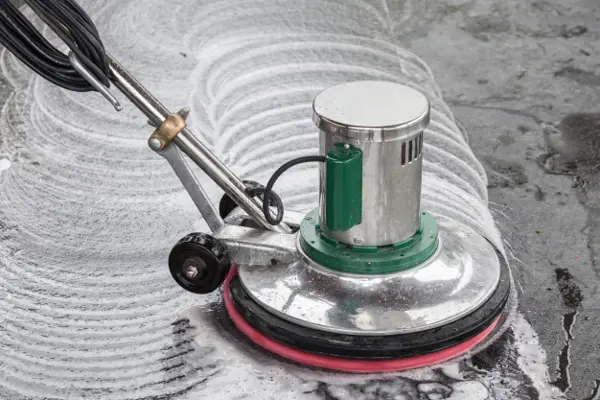
For deeper cleaning, on the other hand, the use of a single disc machine equipped with red or black scotch brite , or a floor scrubber equipped with semi-rigid brushes, is recommended.
As far as resin coatings are concerned, it is good to pay attention to the type of medium used.
If the surface is smooth , a scrubber-dryer or single-disc machine equipped with a medium-hard bristle brush (preferably softer), or a low-abrasive disc is sufficient. If the surface has medium roughness , the brushes of the scrubber-dryer or single-disc machine can be equipped with rougher brushes.
The pressure washer with pressure jet is, on the other hand, to be used only if indicated by the manufacturer.
It is important to remember that in general, resin coatings (epoxy, polyurethane, methacrylic, etc.) resist temperatures up to a maximum of 50°C. Only with some formulations (polyurethane-cement) it is possible to reach up to about 100°C.
For easy cleaning on concrete floors , you can use the sweeper.
For deeper cleaning, on the other hand, the use of a single disc machine equipped with red or black scotch brite , or a floor scrubber equipped with semi-rigid brushes, is recommended.
As far as resin coatings are concerned, it is good to pay attention to the type of medium used.
If the surface is smooth , a scrubber-dryer or single-disc machine equipped with a medium-hard bristle brush (preferably softer), or a low-abrasive disc is sufficient. If the surface has medium roughness , the brushes of the scrubber-dryer or single-disc machine can be equipped with rougher brushes.
The pressure washer with pressure jet is, on the other hand, to be used only if indicated by the manufacturer.
It is important to remember that in general, resin coatings (epoxy, polyurethane, methacrylic, etc.) resist temperatures up to a maximum of 50°C. Only with some formulations (polyurethane-cement) it is possible to reach up to about 100°C.
4. What cleaning methods should be used in the first few days after the resin coating has been made?
In the first few days after the coating has been made , it is advisable to pay more attention to cleaning operations, as the coating will gradually reach its maximum resistance. Therefore, it is not recommended to subject the coating to contact with liquids (water, alcohol, acid thinners) for at least 3 days, maintaining a temperature of at least 20°C. As the temperature decreases, the catalyzing times increase and consequently the time of use of the flooring, especially for contact with water or various liquids and the support of an object that has a moisture content (e.g. wet pallet or other) and with an environmental relative humidity of more than 80%. Under these conditions, it is advisable to carry out a carbonation test by placing water on a small surface of the flooring: the contact must not whiten the coating.
5. Can oils or impregnating substances be removed from the concrete floor?
Concrete is a porous material, so it tends to absorb the liquids it comes into contact with to varying degrees. Very small quantities of oily or impregnating substances, if immediately removed, do not cause damage, while in the case of large quantities and a long and constant stay on the flooring it is no longer possible to remove them as the liquid penetrates inside the flooring. In the most serious situations, where the flooring is ruined and contaminated by these substances, it is restored in concrete and/or with resin coating.